
What is AI Filmmaking? A Complete Beginner's Guide (2026)
- Chithralok Academy

- Jul 8
- 5 min read
Updated: Jul 8
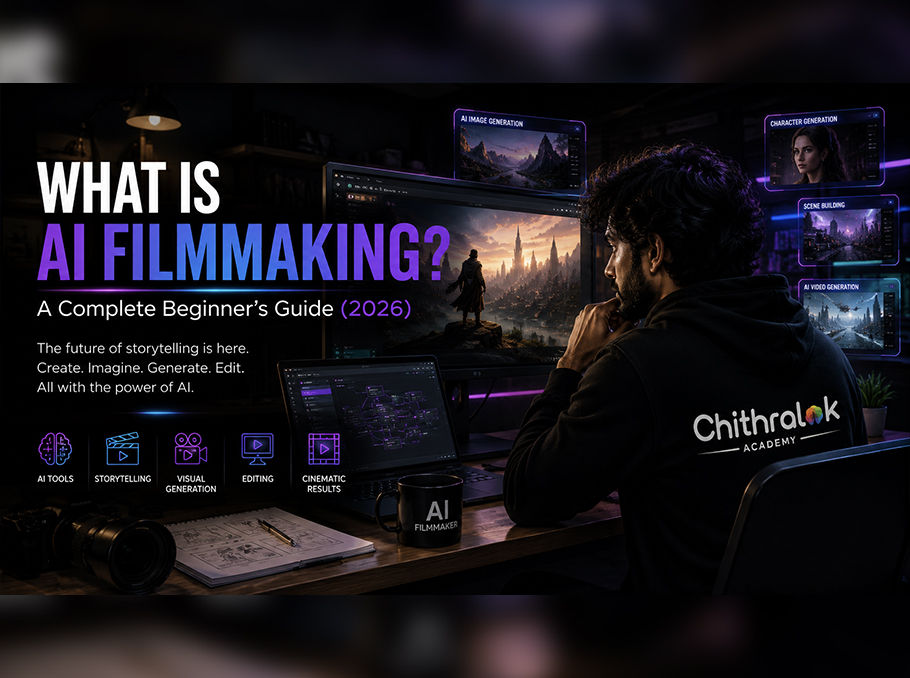
Artificial Intelligence is revolutionizing the way movies, advertisements, YouTube videos, music videos, and digital content are created. What once required expensive cameras, large production teams, and months of editing can now be accelerated with the help of powerful AI tools.
AI Filmmaking is the process of using Artificial Intelligence to assist in every stage of filmmaking—from generating ideas and writing scripts to creating characters, designing cinematic environments, producing AI-generated videos, and editing the final output.
However, AI is not replacing filmmakers. Instead, it is becoming a creative partner that helps storytellers bring their imagination to life faster than ever before.
Whether you're a filmmaker, content creator, designer, marketer, entrepreneur, or student, learning AI filmmaking can open up exciting creative and career opportunities.
Why AI Filmmaking is Growing So Fast
The demand for video content has never been higher. Businesses, brands, influencers, agencies, and filmmakers need high-quality videos faster than ever.
AI enables creators to:
Produce cinematic visuals in minutes
Reduce production costs
Experiment with multiple creative ideas quickly
Build content without large crews
Create realistic fantasy and futuristic worlds
Improve productivity while maintaining creative control
This is why AI filmmaking has become one of the fastest-growing creative skills in 2026.
Traditional Filmmaking vs AI Filmmaking
Traditional Filmmaking | AI Filmmaking |
Large production crew | Smaller, agile teams |
Expensive cameras and equipment | AI-assisted visual creation |
Physical locations | AI-generated environments |
Long production timelines | Faster production workflows |
Higher production costs | More cost-efficient for many projects |
Manual concept design | AI-assisted ideation and visualization |
AI doesn't eliminate traditional filmmaking—it complements it by making many parts of the workflow faster and more flexible.

Complete AI Filmmaking Workflow
Professional AI filmmaking follows a structured creative process.
Step 1 – Story Development
Every great film starts with an idea. AI can help brainstorm concepts, but the story still comes from the filmmaker.
Step 2 – Script Writing
Develop the screenplay, dialogues, and scene descriptions.
Tools like ChatGPT can help generate ideas, refine scenes, and improve storytelling.
Step 3 – Storyboarding
Visualize every scene before production.
A storyboard helps define:
Camera angles
Scene composition
Character positions
Shot flow
Step 4 – Character Creation
Create realistic and consistent characters using AI image-generation platforms.
Define:
Face
Hairstyle
Clothing
Body structure
Expressions
Maintaining consistency across scenes is a key skill for AI filmmakers.
Step 5 – Costume Design
Design outfits that match the story, era, and character personality.
AI makes it possible to test multiple costume concepts before production.
Step 6 – Environment Design
Generate cinematic backgrounds such as:
Forests
Mountains
Castles
Futuristic cities
Villages
Corporate offices
These environments become the world in which your story unfolds.
Step 7 – Prompt Engineering
Prompt engineering is one of the most important skills in AI filmmaking.
A well-written prompt defines:
Character
Costume
Environment
Camera angle
Lens
Lighting
Mood
Color grading
Visual style
The better your prompts, the more consistent and cinematic your outputs will be.
Step 8 – AI Image Generation
Transform prompts into high-quality visuals using AI image generation platforms.
These images become concept art, storyboards, or keyframes for AI video generation.
Step 9 – AI Video Generation
Convert images and prompts into cinematic motion using AI video tools.
This stage brings characters, environments, and camera movements to life.
Step 10 – Post Production
Professional editing includes:
Color correction
Sound design
Background music
Titles
Transitions
Visual effects
AI-generated content becomes much more polished when combined with professional editing techniques.

Best AI Tools for Filmmakers in 2026
A modern AI filmmaker often works with multiple tools, each serving a different purpose:
ChatGPT
For brainstorming ideas, writing scripts, creating dialogues, and refining prompts.
Midjourney
Ideal for cinematic concept art, characters, environments, and visual inspiration.
Nano Banana
Useful for advanced AI image generation workflows.
Gemini
Supports research, ideation, and creative planning.
Kling
Generates realistic AI videos with dynamic motion.
Veo
Creates high-quality cinematic videos with advanced scene understanding.
Grok
Assists with creative ideation and research.
Higgsfield
Provides advanced cinematic AI video generation with creative control.
OpenArt
Useful for generating stylized images, maintaining visual consistency, and experimenting with different artistic directions.

Technical Skills Every AI Filmmaker Should Learn
AI tools are only part of the equation. Strong filmmaking fundamentals are equally important.
Professional AI filmmakers should understand:
Storytelling
Storyboarding
Shot composition
Camera angles
Camera movements
Lighting
Color theory
Prompt engineering
Editing workflows
Visual storytelling
They should also be comfortable using industry-standard software such as:
Adobe Photoshop
Adobe Premiere Pro
Adobe After Effects (Basics)
Combining creative fundamentals with AI tools produces far stronger results than relying on AI alone.
Career Opportunities in AI Filmmaking
AI filmmaking is creating new opportunities across creative industries.
Potential roles include:
AI Filmmaker
AI Content Creator
AI Video Editor
Prompt Engineer
Creative Director
Commercial Filmmaker
Social Media Video Producer
Advertising Creative
YouTube Creator
Freelance AI Artist
As AI becomes more widely adopted, professionals who understand both filmmaking and AI workflows are likely to be in high demand.Is AI Replacing Filmmakers?
No.
AI is changing how films are produced, but it is not replacing creativity, storytelling, or human emotion.
A compelling story still depends on human imagination, direction, and artistic judgment.
The filmmakers who embrace AI as a creative tool—rather than viewing it as a replacement—are likely to be best positioned for the future.
How to Start Learning AI Filmmaking
The most effective way to learn AI filmmaking is through practical, project-based training that combines AI platforms with filmmaking principles.
A comprehensive course should cover:
AI platforms and workflows
Prompt engineering
Storyboarding
Character and environment design
Camera language
Photoshop
Premiere Pro
Basic After Effects
Portfolio development
Real-world projects
The focus should be on creating complete films, not just learning individual tools.
Conclusion
AI filmmaking is opening up new creative possibilities for storytellers, filmmakers, and content creators. By combining AI with traditional filmmaking knowledge, creators can produce cinematic content more efficiently while maintaining artistic control.
Learning AI filmmaking is not just about mastering software—it is about understanding storytelling, visual language, and the creative process behind every film.
For anyone interested in the future of filmmaking, now is an excellent time to begin exploring this rapidly evolving field.

Frequently Asked Questions
What is AI filmmaking?
AI filmmaking is the use of artificial intelligence to assist with tasks such as script writing, storyboarding, image generation, video creation, editing, and visual effects while keeping creative decisions in the hands of the filmmaker.
Do I need prior filmmaking experience?
No. Beginners can start learning AI filmmaking by combining AI tools with foundational filmmaking concepts.
Can AI create an entire movie?
AI can help with many stages of production, but human creativity is still essential for storytelling, direction, editing, and emotional impact.
Which software should I learn?
A strong foundation includes AI platforms along with Adobe Photoshop, Adobe Premiere Pro, and basic Adobe After Effects.
Is AI filmmaking a good career?
Yes. As businesses, agencies, and creators increasingly use AI-generated content, opportunities in AI filmmaking continue to grow.
Comments